


Exotic Bully Judging Standard – Clean Exotic Block Type (International Edition)
📘 Breed Standard and Judging FrameworkExotic Bully – Clean Exotic Block Type (International Edition)
Authored & Developed by:
Ake Ronin | 2025
Reviewed & Advised by:
Mamimah Maria Recoter
(International Judge – Philippines)
Philosophy of the Standard
The Exotic Bully – Clean Exotic Block Type Breed Standard
has been developed by practitioners actively working in the field,
with the purpose of establishing a shared reference grounded in
structural reality,
not trends or personal preference.
The Exotic Bully does not seek “new rules,”
but rather a shared understanding that all parties can rely upon equally.
Over the past decade, the Exotic Bully has grown rapidly worldwide.
However, a common language has been lacking—one that allows judges, breeders,
and exhibitors to evaluate dogs under the same structural principles
in a systematic manner.
As a result, differences have emerged in judging outcomes,
interpretations of health, and directions of breed development.
This standard has therefore been established to create
a central system of understanding,
based on four core principles fundamental to the Exotic Bully breed:
Type – A distinct identity unique to the Exotic Bully, clearly differentiated from the American Bully, French Bulldog, or other Bulldog breeds, without reliance on any single bloodline.
Mass – Structural density that reflects strength and stability, maintained within limits that do not compromise standing, movement, or healthy respiration.
Symmetry – Balance in all dimensions: left–right, front–rear, and top–bottom, expressed harmoniously.
Function – Stable and efficient movement that reflects sound structure, even as a companion breed.
This standard is not written to “create divisions,”
but to establish a common foundation upon which all can stand—
whether judges seeking clear criteria,
breeders seeking a correct developmental direction,
or exhibitors seeking a fair and transparent platform.
Judging is not conducted to elevate any individual name,
but to uphold the value of what is correct.
This standard is founded on the belief that:
“A good dog may not be the most popular dog,
but it is the dog that can endure the longest.”
Because correct structure is the root of health,
health is the root of development,
and development is the root of long-term breed sustainability.
This document is intended as a Living Standard,
to grow alongside the field, evolve with emerging health data,
and be continuously refined through real-world experience.
The ultimate purpose of this standard is to restore:
dignity to breeding,
fairness to judging,
and pride to every life that stands on the same stage.
Breed Origin & Historical Development
The Exotic Bully breed began to show a clearly defined developmental direction in the early 2010s, originating from American Bully bloodlines. Early developers sought to further refine the breed toward a more compact, dense structure with a distinctive head type, establishing a Bull-type companion dog with an identity clearly differentiated from the traditional American Bully.
In its early stages, the development of the Exotic Bully emerged across multiple regions without a unified structural framework. This resulted in variations in phenotype shaped by differing concepts and objectives among individual developers. Such diversity reflects a natural phase of identity exploration and directional refinement commonly observed during the development of an emerging breed.
Through accumulated field experience and long-term observation of overall structure, a more defined developmental perspective gradually formed. This approach emphasized preserving the Exotic Bully’s distinctive mass and presence, while also considering the relationship between structure, proportion, and movement, allowing the dog to maintain a strong, dense body type with movement that remains consistent with its own characteristics—without forcing structure or compromising overall balance.
Although the Exotic Bully is rooted in the American Bully, its structural concepts have been influenced by Bulldog-type breeds such as the English Bulldog and French Bulldog, particularly in terms of balance, compactness, and the distribution of body mass in relation to supporting structure. However, these influences have been adapted within the context of the Exotic Bully, with emphasis placed on proportional balance and functional movement rather than direct imitation of other breeds.
This developmental direction gradually crystallized into what is now referred to as the Clean Exotic Block Type, which is based on a harmonious relationship between head structure, body mass, proportional balance, and movement consistent with the unique characteristics of the Exotic Bully. This approach preserves the powerful presence of a Bull-type dog while maintaining balance and suitability for practical evaluation in the show ring, as well as sustainable long-term breed development.
Scope of Application
This standard is intended to serve as a guideline for:
• Conformation judging in the show ring
• Education and training of judges and adjudicators
• Breed development planning
• Reference use for academic study and breed health considerations
This document is designed to function as a central communication framework within the show environment.
It does not replace, override, or conflict with the standards of any international registry or organization.
Rather, it serves as an interpretive framework for the Exotic Bully – Clean Exotic Block Type, with emphasis on structural correctness, health, and long-term genetic sustainability.
This standard is open for reference by all countries and organizations to support shared understanding in judging and breed development, with the ultimate objective of improving overall quality and welfare of the Exotic Bully breed worldwide.
Ethical Use of the Standard
This standard shall be applied to support breed development, not to create division or discredit others.
No criterion shall be interpreted in a manner that favors specific individuals or bloodlines.
Judging shall be based on true structure, not on presentation, reputation, or name recognition.
All exhibitors shall be treated with equal respect and fairness.
Revision & Validity
This breed standard is established as a Living Standard and shall be subject to review at least every two (2) years, or when new information related to health, genetics, or structural considerations becomes available and is relevant to the development and evaluation of the Exotic Bully breed.
The current edition is effective from 2025 onward and shall serve as the Primary Reference for judging and breed development of the Exotic Bully – Clean Exotic Block Type.
This standard is applied under the collaborative framework of TPKC × PABR, as well as partner organizations that adhere to the core principles of:
Type – Mass – Symmetry – Function.
The purpose of this standard is to function as a Unified Field Framework of understanding within the show environment.
It is not intended to replace or override the standards of any international registry. Rather, it is open for reference, study, and practical application by all countries and organizations that are committed to improving the quality and welfare of the Exotic Bully breed.
Such use is subject to the condition that the standard shall not be altered for the benefit of any specific group, and that its application shall consistently adhere to principles of ethical practice and academic accuracy.
📘 Judging Standard – Front View Head Structure
Breed: Exotic Bully – Clean Exotic Block Head
🔶 Section: Head Type & Structural Soundness
A structurally solid Block Head is one of the defining characteristics that truly represents the identity of the Exotic Bully breed.
The head must be broad, full in proportion, and convey a sense of firmness and stability. The mass of the head should be balanced with the jaw structure.
🔶 Desirable Traits
• Block Head shape: Broad, solid, and well-filled
• No taper at the muzzle: The muzzle should not become pointed or narrow toward the front in a manner inconsistent with jaw mass
✅ The head should demonstrate consistent structural firmness throughout, with no detectable depression or abnormal softness at the top skull or crown. When palpated, the skull should feel evenly firm, without hollow spaces beneath the skin.
• The jawline should be clearly defined, with mass proportional to the head
• Nostrils should be open; breathing must remain unimpeded
⚠️ Section: Faults
• Tapered Muzzle:
A muzzle that is visibly narrower than the width of the jaw framework may result in imbalance of the chin and jawline, which is inconsistent with the Block Type head structure that emphasizes lower mass and stability.
(An exception may be considered when the jaw structure is clearly defined, the masseter muscles are well developed, and the chin remains stable, even if the muzzle is slightly narrower than ideal.)
• Pronounced bulging or doming of the top skull or crown
• The central crown area exhibits compressibility or abnormal softness when palpated
• Jawline deviation, insufficient mass, or lack of proportional relationship to the head structure
🔍 Transitional Period Judging Note
In cases where a dog presents characteristics closer to a Rounded Skull, but:
• Displays a clearly defined jawline
• Maintains normal breathing
• Shows overall head structure that remains harmonious with the body
The dog may be considered Acceptable, with a score lower than that of a fully developed Block Head.
💡 Structural & Genetic Rationale
Block Head structure is not merely an aesthetic trait, but a fundamental structural characteristic reflecting balanced genetics within the breed.
A well-developed Block Head:
• Supports stable jaw alignment, helping to reduce irregular bite presentation
• Reflects skull strength, which may correlate with reduced structural vulnerability at the cranial level
📏 Approximate Ideal Proportions
The following ratios are provided as approximate structural guidelines, derived from observation of multiple dogs exhibiting excellent head structure within the Clean Exotic Block Type.
These proportions are intended to describe balanced structural relationships commonly observed in high-quality examples of the type, particularly in dogs that demonstrate clear skull width, jaw balance, facial symmetry, and head mass appropriate to the breed.
They are provided as reference guidelines for education and judging consistency only, and are not intended to represent, endorse, or be associated with any individual dog, owner, kennel, bloodline, or organization.
• Skull Width : Jaw Width ≈ 1 : 0.95
→ Indicates lower head fullness without narrowing or collapse
• Eye-to-Chin : Eye-to-Top ≈ 1 : 0.8
→ Reflects vertical balance without excessive top heaviness
• Eye Width : Mouth Width ≈ 1 : 1
→ Indicates a muzzle that remains consistent in width without tapering
🧠 Note: These proportions are intended as developmental and evaluation guidelines only. They are not to be applied as mathematical measurements or judged from photographs.
🔸 Clean Face Presentation
• Forehead skin should appear naturally smooth and firm at rest, without pronounced vertical or horizontal wrinkles
• Forehead firmness contributes to the overall impression of a “Clean Head,” enhancing balance, strength, and clarity of expression
• Facial skin should lie close to the underlying structure; minor natural wrinkles may be present but must not be deep, loose, or disruptive to head balance or expression
• Cheek and chin musculature should be firm, with shallow grooves only
• Transitions between nasal bridge, chin, and mouth should appear clean, defined, and aligned
🔸 Jawline & Bite Symmetry
• The chin and lower jaw must be full and substantial, with mass balanced relative to the skull
• The jawline should not recede, collapse, or deviate to either side
• Bite alignment should correspond with chin firmness and should not indicate jaw misalignment
✅ A sound jaw structure forms the foundation of both appearance and oral health.
🔸 Eyes
Eyes should be medium in size and fall within forms that remain balanced with the facial structure, including:
• Almond Eyes: Naturally elongated with smooth upper and lower contours; neither protruding nor overly round
• Tight Almond: A more compact, well-set almond shape, appearing firm within the eye socket
• Clean Oval: Clearly defined oval shape without loose skin or wrinkles affecting the eyelids, presenting a clean and alert appearance
Overall, the eyes should not appear protruding, sunken, drooping, or loose, and must be positioned in harmony with skull width and stop alignment. When eye structure and brow placement are balanced with the head, the presentation is considered desirable within the Clean Exotic Block Type.
Eyes regarded as “good” should convey clarity, firmness, alertness, and composure.
🔸 Judging Notes
• Evaluate the overall alignment and symmetry of the skull, jaw, and eye placement
• Consider mass, symmetry, and bite collectively rather than in isolation
✅ A correct Clean Exotic head should communicate power, solidity, and balance, without reliance on misleading visual exaggeration.
✅ Summary
An Exotic Clean Head represents a balanced, broad, and solid head structure that expresses true breed identity without artificial exaggeration.
– Balance must exist between skull, chin, eyes, and facial planes
– The structure should demonstrate stability and suitability for long-term development
📘 Judging Standard – Side View Head Structure
Breed: Exotic Bully – Clean Exotic Block Type
🔹 1. General Side View Profile
The side view of the head in the Exotic Bully – Clean Block Type should present a broad, dense, and symmetrical appearance.
✅ The skull and muzzle plane must appear harmonious and structurally genuine, without visual illusion.
🔸 2. Skull Form & Proportion
• Block Head structure: Wide base, dense mass, and symmetrical form
• Balanced proportions left–right and top–bottom
📏 Skull Length : Muzzle Length ≈ 3.8 – 4.2 : 1
→ This ratio represents an approximate guideline observed in high-quality examples of the Exotic Clean Head type, reflecting a clearly defined skull structure and muzzle proportion consistent with the Clean Exotic Block Type.
✅ Clearly expresses Exotic Clean Head type rather than a Classic Bully presentation.
🔸 3. Stop & Muzzle
• Stop: Deep break (approximately 90°) with a clearly defined transition point
• Muzzle: Very short (≈ 1 : 4.2 of total head length)
• Muzzle plane: Flat and parallel to the mid-eye line
• Nose tip: Positioned approximately 0.5–1 cm below the mid-eye level
• Muzzle width: Full through to the cheek area; no tapering or narrowing toward the tip
✅ A flat muzzle must not turn upward, curve, or collapse inward.
• ✅ A slightly longer muzzle may be acceptable, provided that:
- Stop remains approximately 90°
- Muzzle plane remains flat and parallel to the mid-eye line
- Overall head balance clearly retains Clean Exotic Block Type characteristics
• ❗ If the muzzle length increases to the point where the stop loses definition or the plane becomes curved or pinched, it is considered outside the Clean Exotic framework and should be scored according to the level of deviation.
🔸 4. Lower Jaw & Chin
• Lower jaw should be dense and deep
• Chin must not recede or collapse and should remain balanced with the muzzle
• Jaw alignment should be symmetrical and free from deviation
📏 Jaw Depth : Muzzle Height ≈ 1.2 : 1
✅ A well-developed jaw contributes to a solid, balanced facial appearance and supports proper bite alignment.
🔸 5. Lips & Clean Face
• Lips should be firm and well-fitted, without excessive looseness
• Deep wrinkles are undesirable
• Shallow muscular grooves along the cheek area are acceptable and natural
✅ “Clean Face” refers to the absence of structural distortion; it does not require an unnaturally tight or rigid appearance.
🔸 6. Symmetry & Balance Criteria
• Front and side views should connect harmoniously
• No twisting, tilting, or collapse at any structural point
• Eye – nose – jaw should align along a consistent structural axis
🔸 7. Judging Notes
• A correct side-view head must display a truly flat muzzle, not merely a short but upturned one
• A defined stop combined with a deep jaw and firm chin establishes proper head balance
✅ Evaluation should prioritize structural stability, not the impression of density derived solely from the front view.
✅ Summary
A correct Clean Exotic head is not defined solely by shortness or frontal mass.
It must demonstrate: Flat muzzle – Balanced structure – Full jaw – Clean face.
– No tapering at the muzzle tip
– Muzzle width should remain consistent to the end, without narrowing into a pointed or thin appearance
– Lip edges should remain firm and full, without drooping or looseness
📘 Judging Standard – Front View Forelimb Structure
Breed: Exotic Bully – Clean Exotic Block Type
🔹 1. General Forelimb Presentation (Front View)
The forelimbs should be positioned with stability, capable of supporting the chest mass in a balanced manner and proportionate to the width of the brisket base.
✅ A slight curvature of the radius–ulna alignment is considered acceptable in this breed, provided it corresponds with a broad, dense chest structure and the forelimbs can genuinely bear weight.
🔸 2. Acceptable Presentation
• Both forelimbs are positioned evenly outside the chest base, without deviation or twisting.
• The radius may display a slight outward bow, which is recognized as an acceptable breed characteristic,
– when consistent with a dense, deep chest base and stable weight-bearing,
– and when it does not negatively affect movement or foot placement.
• Elbows should rest in a natural position, without inward rotation or outward flare that forces the structure,
while remaining capable of stable weight-bearing and without causing forelimb distortion or movement issues.
• Feet may face straight forward or slightly outward, without compromising load-bearing alignment.
📏 Dogs with a dense, thick chest and good chest drop often adjust forelimb alignment to match chest width, which may result in a balanced, slight curvature.
✅ This presentation is not a fault, but a breed-specific characteristic reflecting front mass and stability in the Exotic Bully.
🔸 2.1 Pasterns – Alignment & Stability
The pasterns of the Exotic Bully should:
• Be vertical or slightly angled (0–10°) to provide stable support for body mass.
• Not appear weak or collapsing during standing or movement.
• Not be excessively upright to the extent that movement or flexibility is affected.
📌 Strong pasterns function as a natural shock absorber, distributing impact and contributing to forelimb flexibility.
✅ Proper pasterns must support chest weight without loss of alignment, excessive rebound, or visible instability during movement.
🔸 2.2 Feet – Structure & Orientation
Feet appropriate for the Exotic Clean Block Type should present as follows:
• Compact, strong feet with thick, cushioned pads, proportionate to forearm thickness and overall bone mass.
They should not be too small to support weight, nor overly large or splayed to the point of losing compactness.
• Tight “cat feet” are not required, particularly in dogs with a wide chest base.
• Toes should be moderately tight, with firm pads capable of effective load support.
• Feet may face straight forward or slightly outward (moderate east–west) without loss of balance.
→ This represents the balance point of the Exotic Bully, which emphasizes stability over rigidity.
⚠️ Considerations for Structural Deviations
• Open Feet: Toes spread, splayed, or lacking compactness.
• Flat Feet: Insufficient pad firmness and toe curvature.
• Severe East–West / Splayed Feet: Often associated with improper elbow placement or forelimb angulation.
→ These conditions may affect balance and movement and can indicate underlying structural imbalance.
📌 Although the Exotic Bully is not a working breed, well-structured feet remain the foundation of stable stance and movement, especially in dogs with substantial mass and wide chests.
📌 If curvature or deviation results in dragging, instability during movement, or misaligned foot placement, it exceeds acceptable breed characteristics and indicates a structure with potential long-term health risk.
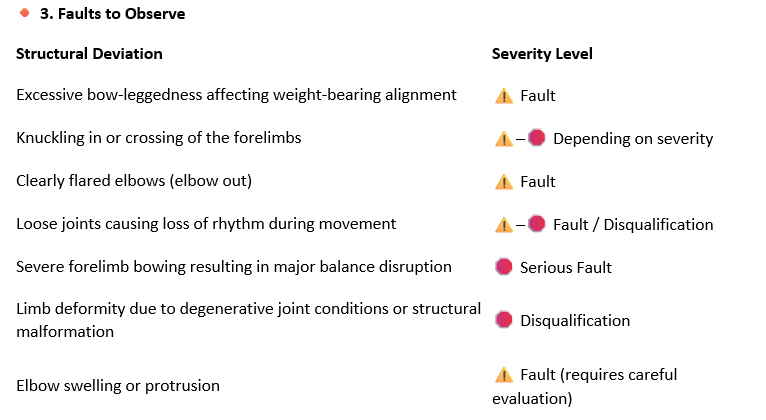
Elbow Swelling / Mass Protrusion
⚠️ Careful evaluation is required to distinguish between breed expression and structural abnormality:
• ✅ Dense muscular development associated with a thick chest base that does not affect elbow alignment or movement may be considered a breed characteristic.
• ❌ Swelling, inflammatory masses, or deformities that cause elbow deviation, lifting, or instability are considered structural faults or disqualifying conditions, depending on severity.
📌 Judging should prioritize elbow stability, limb placement, mass balance, and observable movement in the ring.
🔸 4. Judging Notes
Judges must clearly distinguish between breed-specific characteristics and structural faults.
– Slight forelimb curvature may be accepted when overall structure remains balanced, stable, and free from movement impairment.
✅ Summary
A correct Exotic Bully forelimb structure does not require the straightness of a working breed.
However, it must genuinely support front mass while:
– Maintaining sound movement
– Preserving balance and stability
– Avoiding long-term structural risk
📘 Toe Orientation Standard
Category: Forelimb Structure | Exotic Bully – Clean Exotic Block Type
1) Purpose of Section
This section defines the range of front toe orientation that is considered normal, acceptable, or structurally deviant for the Exotic Bully – Clean Exotic Block Type, in order to provide judges with a consistent framework for evaluating stability, weight-bearing capacity, and overall balance of the forelimb structure.
2) Definition of Toe Orientation
Toe orientation refers to the degree of outward deviation of the front feet when the dog is standing in a natural, relaxed position.
Assessment must be performed on a flat surface, in a calm stance, and not during movement.
3) Standard for Normal / Acceptable Orientation
Due to the naturally wide chest and the higher proportion of front weight-bearing in the Exotic Bully, a slight outward orientation of the front toes may occur as a normal breed variation.
Acceptable range:
• Slight outward orientation not exceeding 10 degrees
This is considered a normal breed variation and is not classified as a fault.
4) Fault Scale
⚠ Minor Faults
• Outward toe orientation of 10–15 degrees
• Overall structure remains stable with adequate weight-bearing
Impact: Slight reduction in overall sharpness of stance without functional limitation
→ Minor point deduction
⚠–🛑 Moderate Faults
• Outward toe orientation of 15–45 degrees
• Begins to affect forelimb balance, such as rotation of the pasterns or forearm alignment
Impact: Standing posture and weight distribution show reduced stability
→ Ranking reduction; may not be considered for higher placements
🛑 Serious Faults
• Outward toe orientation exceeding 45 degrees
• Clearly affects weight-bearing ability or structural stability of the forelimbs
Impact: Structural balance is compromised and unsuitable for high-level competition
→ Should not be awarded major placements
5) Disqualification Criteria
Disqualification applies only when the deviation represents a structural deformity rather than a breed variation.
Disqualification applies when:
• Severe torsional deformity of the front feet is present
• The dog is unable to stand and bear weight in a stable manner
6) Breed-Specific Justification
The Exotic Bully – Clean Exotic Block Type is characterized by a broad chest, high front weight distribution, and a slight natural curvature of the radius bone.
These factors may result in a mild outward toe orientation that is commonly observed within the breed.
Establishing an appropriate standard prevents suppression of true breed characteristics while also preventing unintentional acceptance of structural deviations.
7) Judging Notes
• Evaluation must be conducted only in a natural standing position on a flat surface, not during movement
• Toe orientation must be assessed in relation to the entire forelimb and overall structure, not in isolation
• Slight outward toe orientation is not considered a fault when the overall forelimb structure remains stable
• Interpretation must be based on structural principles, not personal preference
📘 Judging Standard – Top View Structure
Exotic Bully – Clean Exotic Block Type
1. Definition
The top view evaluation assesses mass distribution and left–right symmetry of the dog, observed from the shoulder region through the hips. Emphasis is placed on the compact outline that is characteristic of the Exotic Bully breed.
2. General Overview
The Exotic Bully – Clean Exotic Block Type should present a top-view outline that reflects:
wide shoulders – full hips – short, compact waist.
The body should display a stable structural line, free from deviation or twisting, with a continuous and systematic flow of musculature from the forequarters to the rear.
3. Desirable Traits
3.1 Pronounced Shoulder Mass
• Demonstrates balanced width and thickness of the shoulder region
• Shoulder mass is evenly distributed from left to right
• Serves as a defining feature contributing to a powerful and compact forequarter appearance
3.2 Dense and Stable Rear Mass
• Hip musculature should be fully developed and balanced with the overall body
• The hips should not be excessively narrow and should convey overall density and substance
• The rear outline should project stability and provide appropriate propulsion in relation to the overall structure
✅ Although the Exotic Bully is not developed as a performance or athletic breed, some individuals may display strong rear power, which may be appreciated as a complementary attribute rather than a requirement.
3.3 Short-Coupled Waist
• The waist should be short to moderate in length, supporting a compact and stable body outline consistent with breed type
• Excessively long or overly pinched waists are undesirable, as they detract from the breed’s compact form
• A well-balanced short waist enhances continuity, density, and harmony between the shoulder and hip structure of the Exotic Bully
3.4 Left–Right Symmetry
• Shoulder, body, and hip mass should be comparable on both sides
• Neither side should appear excessively bulged or diminished
• Reflects correct structural and muscular development
4. Acceptable Presentation
• Slight variation in shoulder-to-hip width due to genetic differences
• Natural waist indentation, provided mass stability is maintained on both sides
• Minor irregularity in dorsal musculature, provided overall balance is not compromised
5. Faults
5.1 Minor Faults
• Excessively narrow and elongated waist resulting in loss of compactness
• Slight imbalance between shoulder and hip mass without loss of central alignment
→ Minor point deduction
5.2 Moderate Faults
• Asymmetrical muscular development across the back
• Noticeable lateral structural tilt when viewed from above
• Overall body outline appearing uneven or twisted
→ Ranking reduction
5.3 Serious Faults
• One-sided collapse or distortion of the shoulder or hip resulting in overall imbalance
• Clear and persistent left–right structural deviation
→ Should not be awarded high placements
6. Disqualification
• Structural deformation resulting in a distorted outline
• Severe imbalance between shoulder or hip mass
• Abnormal movement resulting from top-view structural imbalance
→ Disqualification from competition in that event
7. Judging Notes
• The top view serves as a category for confirming true structural integrity in the Exotic Bully
• Essential for distinguishing true mass from visual illusion created by posing or lead handling
• Must not be used in isolation; evaluation must be conducted in conjunction with front and side views
• Prominent shoulder and hip mass are defining characteristics of the Exotic Bully and are not considered faults
📘 Judging Standard – Side Profile Structure
Exotic Bully – Clean Exotic Block Type
1. General Description
The side profile structure of the Exotic Bully should display a compact, solid, and well-balanced outline, with continuous structural flow from neck – shoulder – topline – hips – rear limbs.
The body must support overall mass with stability and clearly reflect the breed’s distinctive type.
2. Structural Details (Ideal Features)
✅ Neck
• Should be thick, dense, and well-coupled
• Length must be proportional to the dog’s height and overall mass
• Free from looseness or an appearance of thin, underdeveloped musculature
• Musculature must be firm, not soft, weak, or fragile in appearance
✅ Shoulder
• Properly sloped and well-laid back
• Neither upright nor excessively collapsed
• Supports balance and stability of the forequarter mass
✅ Chest & Brisket
• The chest should reach elbow level or slightly below, which is characteristic of the compact, low-set Exotic Bully type
• A deep chest should contribute to a low, stable body outline and must not create a “floating” appearance above the ground
• The chest base must be full and dense, with sufficient mass—never flat, hollow, or light
• This structure serves as a primary weight-bearing point for the front assembly and must be strong and substantial in proportion to the breed’s short, solid build
• When evaluated from both the front and side, the chest and forelegs must function together to produce a low-set, grounded, and stable outline
• The body should not appear tall, narrow, airy, or lifted off the ground
• A deep, full chest should help maintain a balanced low body profile without causing sagging or forward imbalance
• Narrow, shallow, flat, or insufficiently developed chests are not acceptable, as they result in a taller, lighter appearance and diminish the breed’s compact low-set identity, indicating inadequate structural support
✅ Body Length & Proportion
The body length of the Exotic Bully must remain proportionate to height in order to preserve a compact, solid, and continuous mass profile, consistent with breed identity.
Excessive body length may cause the outline to appear stretched, reducing the perception of substance and block-type character, and may begin to affect weight distribution and overall structural stability.
Fault-related considerations include:
• Body length exceeding what is appropriate relative to height
• An elongated outline lacking the breed’s characteristic compactness
• Body length that begins to affect balance in stance or movement
✅ Topline
• Short, tight, and level
• A slight natural curve is acceptable
• Must not slope, sag, dip, or twist
• Supports a compact and well-balanced overall outline
✅ Hip & Croup
• Smoothly sloped and continuous from the topline, without abrupt breaks or disruption at the tail set
• No steep drop, abrupt angle, or “high-rear” appearance
✅ Rear Angulation
The rear assembly should:
• Display dense, well-developed musculature, indicating strength and propulsion capability
• Possess bone structure that allows for functional rear angulation, even in short-boned individuals
• Provide effective drive during movement, not merely a static show stance
Desirable Traits:
Rear legs should exhibit strong muscle development with clearly defined muscle lines and angulation balanced to the body’s proportions. In short, compact, and heavily built dogs, rear angulation may appear reduced due to structure, but must remain functional, allowing stable movement, effective drive from hip to foot, and balanced standing posture.
Adequate angulation does not need to be excessive but must not be rigid, collapsed, unstable, or disconnected from overall structure. The rear must work in harmony with musculature and skeletal alignment to support powerful, efficient movement rather than appearance alone.
Faults:
• Insufficient rear musculature or disproportionately small rear assembly
• Straight rear with little to no angulation, resulting in reduced drive
• Angulation that is excessively narrow, misaligned, or outside the dog’s balance axis
• Weak, soft, or improperly positioned hocks
• Movement lacking drive, with insufficient hip engagement
Disqualifications:
• Severely deformed rear limbs or pronounced misalignment
• Severe movement abnormalities
• Inability to move normally or visible pain or dysfunction that compromises quality of life
Note:
In dogs with short bone length and low, compact structure typical of the Clean Exotic Block Type, rear angulation may appear reduced when viewed externally. However, it must demonstrate functional balance, stable movement, and sound support in both stance and motion. Judges must distinguish between naturally limited angulation due to breed structure and insufficient angulation that compromises function and movement.
✅ Tail
🔹 Desirable Traits
The tail of the Exotic Bully should be of moderate length in proportion to the body, with the following characteristics:
• Moderate in length relative to overall body proportion
• Thick, strong tail base without abnormal masses; tapering evenly and naturally toward the tip
• Set in continuation with the topline, without abrupt breaks or angles
• Free from kinks or curls (kink-free, curl-free)
• When in motion, the tail may be carried higher as a natural response to balance and movement
• At rest, the tail should hang low or follow the body line in a balanced manner
• The tail should contribute to overall balance and must not deviate markedly to either side or curl over the back
❌ Faults
• Abnormally short tail (short tail / bobtail)
• Curled tail or tail carried rolled over the back
• Kinked, twisted, or sharply bent tail
• Abnormal masses at the tail base, such as cysts or firm protrusions
• Tail carried distinctly to one side
🟡 3. Acceptable Imperfections
• Minor indentation or narrowing in structure while maintaining overall balance
• Slightly increased body length, provided the outline remains within a compact framework
🔸 Judging Note
Judges should prioritize overall mass flow and balance rather than posed appearance.
Evaluation must consider whether the structure genuinely supports body mass and contributes to effective movement.
📚 4. Judging Mindset
“A sound structure is one that can support itself in reality,
not merely one that relies on momentary visual presentation.”
📘 Standard – Color & Pattern
Breed: Exotic Bully – All Sizes
Color & Pattern
The Exotic Bully may appear in all colors and patterns without restriction, including mixed colors, dilute colors, and various patterns such as merle, brindle, or ticked.
❌ Not Permitted:
Albinism or dogs exhibiting severe lack of pigmentation (e.g., pink eyes, overall pale skin, and absence of nose pigment) are considered serious faults due to health implications.
🔸 Special Category: Merle and Piebald Patterns
For dogs exhibiting merle or piebald patterns, judges should place particular emphasis on evaluating eye color, visual function, and hearing, in accordance with the guidelines outlined in the “Eye Color Standard” and the section addressing sensory-related faults.
✅ Points of observation include:
• Eye colors potentially associated with reduced pigmentation, such as light blue eyes, translucent irises, or poorly defined iris margins
• Adequacy of light response and overall visual capability
• Behavioral indicators of visual impairment, such as light sensitivity, colliding with obstacles, or lack of response to visual stimuli
• Partial or complete hearing loss, which may be observed more frequently in cases of double merle or extreme piebald
❗ If abnormalities are identified that affect basic quality of life, such as blindness, deafness, or clearly abnormal sensory responses, these should be considered serious faults or disqualifying faults, in order to safeguard the long-term genetic quality of the Exotic Bully breed.
🔸 Ears
Ears should be set relatively high on the head and be of a size and shape proportionate to the overall head structure.
Both natural ears and cropped ears are acceptable, with no preference or scoring advantage given to either.
Evaluation should focus on harmony with the head and consistency with the overall Clean Exotic Block presentation.
✅ Acceptable Characteristics
• Natural or cropped ears, appropriately proportioned to the head
• Ear placement that enhances a stable and balanced head appearance
⚠️ Faults
• Ears with a wide base and erect, upright carriage with rounded tips, resembling those of the French Bulldog, are considered inconsistent with the proportions and overall head presentation of the Clean Exotic Block Type
• Ears cropped excessively short, resulting in disproportionately small ear size and disrupting overall head balance
🛑 Disqualifications
• Hearing impairment, whether unilateral or bilateral
🔸 Genital & Reproductive Traits
✅ Male dogs should have two testicles fully descended into the scrotum, with development appropriate for age.
🔸 Faults:
• One testicle abnormally small or clearly asymmetrical in position
→ Considered a general fault provided both testicles are present in the scrotum
→ A deduction may be applied if the condition affects overall balance or presents a clearly noticeable external deviation
📌 Judging Note:
This should not be regarded as a serious fault, unless there is clear evidence of developmental abnormality or an observable impact on quality of life or overall physical soundness.
🛑 Disqualifications:
• Absence of both testicles from the scrotum (Cryptorchidism)
• Presence of only one descended testicle (Monorchidism)
• Neutered dogs (unless permitted by the specific event regulations)
📌 Note:
Reproductive soundness in male dogs is a basic condition reflecting overall health and breeding potential, with long-term implications for breed development.
🔸 MOVEMENT
▪ General Definition:
The Exotic Bully should demonstrate balanced, consistent, and purposeful movement.
Despite a structure characterized by short limbs, large head, broad body, or heavy mass, correct movement must remain in harmony with the physical structure and should not indicate imbalance or abnormalities of joints, muscles, or skeletal system.
✅ Ideal Movement Characteristics
Directional Stability – The dog should move forward in a steady line without drifting or loss of balance, reflecting accurate directional control.
Left–Right Balance – Forelimbs and hindlimbs should move symmetrically, without dragging, stiffness, or excessive weight shift to one side.
Core Stability – The body should remain stable during movement, particularly in dogs with substantial mass, without rolling or instability.
Structural Compatibility – Movement should demonstrate that the dog can utilize its short legs, broad chest, and large head naturally, without strain or abnormal compensation.🔎 Jumping or Lunging During Movement
In Exotic Bullies with very short limbs, minor forward lunging may occasionally be observed during leash movement due to stride length mismatch.
🟢 Considered acceptable when:
• Movement remains smooth, without stumbling, breaking stride, or loss of balance
• The behavior serves to synchronize with the handler’s pace and is not caused by structural abnormality
🔴 Faults include:
• Jumping or lunging resulting from pain, avoidance of discomfort, or compensation for structural deviation
• Inability to move smoothly even at a natural pace
• Dragging limbs or stiff movement
• Limbs spreading outward or deviating from correct alignment
• Lack of rear drive
▪ Additional Judging Guidance:
The Exotic Bully is not designed for endurance movement.
However, correct movement must remain consistent with structure and free from behaviors or signs indicating structural or joint abnormalities.
Judges should not apply movement criteria from Working Group breeds as a direct comparison.
📘 SIZE
Height and weight should be proportionate to overall structure, with height measured at the withers, defined as the highest point of the scapula (shoulder blades) at the base of the neck, not from the back or mid-body.
🔹 Size Varieties
– Nano:
• Males and females: not exceeding 9.0 inches
• Additional requirements:
Despite the small size, the dog must:
– Maintain sound movement
– Exhibit no skeletal deformities
– Show no functional impairment caused by disproportionate dwarfism
– Micro:
• Males: over 9.0 inches up to 13.5 inches
• Females: over 9.0 inches up to 13.0 inches
– Standard:
• Males: over 13.5 inches
• Females: over 13.0 inches
🔹 General Notes:
• There is no weight limit for this breed; however, dogs must not be excessively overweight or lose structural balance.
• Movement is a key evaluation factor and must demonstrate stability, strength, and consistency with overall structure.
🟥 EYE COLOR STANDARD – Exotic Bully
(Based on genetics, iris structure, and visual health)
🔍 1. Acceptable Traits
• All eye colors (brown, amber, blue, etc.) are acceptable if harmonious with coat color and without impact on visual health.
• Blue eyes in dogs carrying dilute genes (Blue, Lilac) or heterozygous merle (M/m) are acceptable provided iris structure is normal.
• Heterochromia is acceptable when symmetrical, with clear iris borders, no cloudiness, translucency, or abnormal pupil response, and no signs of health impairment.
✅ Heterochromia – Acceptable Condition
Definition:
One eye distinctly different in color from the other (e.g., one full blue eye and one full brown eye).
→ Referred to as Complete Heterochromia
→ Acceptable when symmetrical and without visual abnormality.
🟠 2. Minor Faults
• Asymmetrical heterochromia or partial blue (sectoral heterochromia)
→ Provided the iris structure remains normal:
– Clear iris margins
– No cloudiness or translucency
– Normal pupillary response to light
– No observable visual impairment
Structural Eye Abnormalities
The following conditions must be evaluated according to their persistence, visibility, and impact on the dog’s vision or welfare. They should not be judged based on external appearance alone.
🟠 Minor Fault
- Slight ocular alignment deviation, or intermittent deviation
- Does not affect vision, balance, or movement
⚠️ Moderate Fault
- Strabismus, exophthalmos, or ocular asymmetry that is clearly visible under normal conditions
- May have a minor impact on facial balance, expression, or spatial awareness
❌ Serious Faults / Disqualifications
- Persistent strabismus that affects vision or balance
- Exophthalmos that presents a risk of injury or indicates abnormal orbital structure
- Severe ocular asymmetry associated with visual abnormality, abnormal response to stimuli, or welfare concern.
Iris Hypoplasia:
• Translucent iris where the pupil is clearly visible under normal light
• Starburst iris pattern
• Blurred or poorly defined iris margins
• Irregular iris pigmentation or blue encroachment distorting circular iris shape
Abnormal Blue Eyes:
• Abnormal ocular reflection or excessively bright blue under normal lighting, often associated with severe pigment deficiency such as:
– Albinism
– Double merle
– Iris hypoplasia
• Blue eyes associated with high-risk genetics, including:
▫️ Double merle (M/M)
▫️ Extreme piebald (white coverage exceeding 80%)
Note:
If blue eyes are present in extreme piebald dogs along with one or more of the following:
– Translucent iris
– Poorly defined iris margins
– Behavioral signs of visual impairment (e.g., photophobia, collision with objects, lack of light response)
→ The dog should be disqualified or heavily penalized to protect long-term breed quality.
Functional Vision Defects:
• Photophobia
• Delayed response to light or sound
• Poor spatial awareness or instability during movement
Pupillary Abnormalities:
• Corneal opacity
• Non-reactive pupils
📌 Judges’ Guidelines
• Eye color alone is not a primary judging criterion and must be assessed in conjunction with facial structure and overall health.
• Merle (M/m): Certain blue eye expressions are acceptable if the iris is not translucent and no functional defects are present.
• If blue eyes are accompanied by:
– Abnormally thin iris
– Abnormal light reflection
– Behavioral signs of impaired vision
→ Immediate disqualification is recommended.
• Carefully distinguish the cause of blue eyes:
– From dilute or heterozygous merle genetics → acceptable
– From structural conditions (e.g., hypoplasia, albinism) → serious fault
🧬 Appendix: Relevant Genetic Terminology
• Dilute gene (dd): Produces diluted coat colors such as Blue and Lilac
• Merle gene:
– Heterozygous (M/m) → Acceptable
– Homozygous (M/M) → High risk; not recommended for breeding
• Piebald gene (sp/sp):
Dogs with extensive white coverage (>80%), especially around the head and ears, should undergo appropriate hearing and vision health evaluations prior to breeding use.
✅ Application Guidelines:
• To be used in conjunction with the Breed Standard sections on Eyes and Head
• Prioritize ocular health and iris structure before considering eye color as a secondary factor
• Aim to preserve opportunities for phenotypically sound and healthy dogs, even when eye color differs within safe and acceptable parameters
Academic References:
→ Clark LA et al., 2006 (Merle phenotype and deafness)
→ Plummer CE et al., 2012 (Merle ocular structure defects)
→ OFA & Canine Eye Registry Foundation (CERF) data
🧠 Exotic Clean Head – Muzzle Zone
Category: Muzzle–Nose–Bite Structure
Flat Muzzle – Balanced Bite – Compact Lips – Proper Nose Set
References: AVDC, ACVS, WSAVA, Fasanella et al. (2010), Oechtering et al. (2010)
🔹 1. Purpose of This Section
To evaluate the structural balance of the muzzle zone, comprising the muzzle, nose, and bite, with emphasis on integrating distinctive breed structure with functional soundness. This includes considerations of breathing efficiency, mastication, hygiene, and overall head symmetry.
🔹 2. Muzzle Structure (Flat Muzzle)
• Desirable Traits:
▫️ A flat plane from the stop to the nose tip
▫️ No upward tilt, curvature, or convex profile
• Points of Caution:
▫️ An excessively short muzzle may increase the risk of BOAS
🔹 3. Lips
• Desirable Traits:
▫️ Lips should be compact and well-fitted
▫️ Not overly thick or pendulous
▫️ Clean lip margins, without gaping or sagging
▫️ Contribute to a defined Clean Head appearance
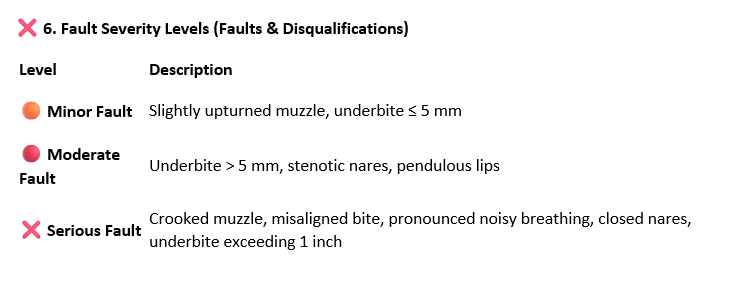
• Faults:
▫️ Thick, loose, or drooping lips
🔹 4. Bite
• Acceptable Bite Types:
▫️ Scissor Bite
▫️ Level Bite
▫️ Slight Reverse Scissor Bite
• Faults:
▫️ Underbite exceeding 5 mm
▫️ Crowded teeth or misaligned bite
▫️ Imbalanced jaw alignment
🔹 5. Nose Structure
• Desirable Traits:
▫️ Nose tip positioned approximately 0.5–1 cm below the mid-eye line
▫️ Open nares, proportionate to muzzle size
▫️ Full pigmentation (solid black, liver, or blue in accordance with coat color)
• Faults:
▫️ Stenotic nares
▫️ High nose set
▫️ Lack of pigment (Dudley or piebald nose)
📘 Additional Notes (Important)
• A correct muzzle in Exotic Bully should be “short but functional,” not “short but compromised.”
• Bite evaluation should be conducted under calm conditions, not during snapping or playful biting.
• Open nares must be assessed in conjunction with actual breathing performance, including under mild excitement.
8. Tongue (Tongue Function & Position)
Desirable Characteristics
• The dog should be able to keep the tongue naturally inside the mouth while standing at rest or in a relaxed state.
• The tip of the tongue should be moist and of normal coloration, not dry or dull.
• No lateral deviation of the tongue or sideways protrusion.
• Tongue position should correspond appropriately with muzzle length and correct bite.
Points of Concern
• Occasional tongue protrusion due to excitement or high ambient temperature is not considered a fault.
• Assessment must be made in conjunction with the overall muzzle zone structure, including lips, chin, and oral cavity.
Functional Abnormalities (Functional Faults)
Persistent Tongue Protrusion
A condition in which the tongue protrudes continuously outside the mouth, even at rest, and cannot be retracted naturally.
This is considered a functional fault, reflecting imbalance within the muzzle zone, such as:
– Reduced oral capacity
– Lip incompetence
– Malocclusion
– Relative macroglossia (tongue size exceeding available oral space)
Fault Scale
🟠 Minor Fault
• Intermittent tongue tip protrusion during calm conditions, with the ability to retract.
🔴 Moderate Fault
• Tongue protrudes while standing at rest but can be retracted intermittently.
• Tongue tip begins to appear dry or dull.
❌ Serious Functional Fault / Disqualification
• Persistent tongue protrusion with inability to retract naturally.
• Continuous protrusion exceeding one-quarter of total tongue length.
• Occurs in conjunction with abnormal breathing or difficulty swallowing.
📘 Judging Notes (Critical for Judges)
Tongue evaluation must be conducted under three conditions:
At rest
During slow walking
Under mild excitementThis is to differentiate between:
• Normal panting, and
• Persistent structural tongue protrusion due to imbalance.
References: AVDC (2018), ACVS (BOAS Guidelines), WSAVA Welfare Guidelines (2021),
Fasanella et al. (2010), Oechtering et al. (2010)
📘 Temperament & Behavior
Classification and Impact on Judging
Behavior is not categorized as Minor Fault, Fault, or Serious Fault, as it is not a structural component subject to point-based evaluation.
Behavior is assessed solely to determine whether the dog is suitable for ranking.
🔴 Disqualification – Behavior
A dog shall be disqualified from ranking in that round if it exhibits any of the following in the show ring:
• Clear aggression toward people
• Uncontrollable aggression toward other dogs
• Inability to undergo structural examination or movement evaluation
• Severe fearfulness rendering proper assessment impossible
📌 Assessment is based only on in-ring behavior.
🔹 Judge’s Discretion Notice
Although disqualifying behaviors are clearly defined in this standard, judges are expected to apply sound professional judgment when evaluating each case, considering intent, actual structure, and impact on health and functional ability.
Temporary reactions during examination—such as tension, excitement, or sensitivity to handling—that do not reflect true aggression, structural abnormality, or health impairment should not be used as automatic grounds for disqualification.
In cases where certain sections cannot be fully assessed, the judge may choose to withhold scoring for that section without considering it a penalty or disqualification, provided the overall structure, health, and movement remain within acceptable parameters.
This standard is intended to safeguard fairness, safety, and dignity for every dog in the ring, not to impose penalties based on circumstances that do not reflect the dog’s true quality.
📘 Coat Standard
Exotic Bully – Clean Exotic Block Type
1. Definition
The coat of the Exotic Bully serves as an indicator of skin health, structural soundness, and overall cleanliness of the breed.
While the coat is not a primary category in structural evaluation, appropriate coat characteristics help confirm balance, firmness, and overall quality of the dog.
2. Desirable Traits
• Short, dense coat lying close to the body
• Smooth, resilient texture; not coarse
• Even coat distribution throughout the body
• Skin firm and tight, without abnormal looseness or excessive wrinkling
• Reflects good health, with no obvious signs of irritation or abnormality
✅ A proper coat should enhance a Clean – Compact – Solid appearance and must not obscure the true body structure.
3. Acceptable Presentation
• Slightly thinner or coarser coat due to seasonal change or age
• Minor variation in coat density in certain areas, provided overall balance is maintained
4. Faults
⚠️ Minor Faults
• Coat slightly coarser or harsher than typical
• Patchy thinning not associated with skin disease
• Mild dryness or lack of sheen
→ A slight deduction may be applied if overall cleanliness and breed quality are affected.
⚠️–🛑 Moderate Faults
• Clearly curly or wavy coat
• Coat longer than typical for the breed
• Loose or wrinkled skin that obscures true structure
→ Ranking should be reduced, as these traits do not align with the Clean Exotic Block Type.
5. Disqualifications
• Clearly long coat (Long Coat)
• Coat characteristics indicating obvious long-coated breed influence
→ Not eligible for placement under this standard.
6. Judging Notes
• The coat is a supporting factor used to confirm cleanliness and overall skin health; it is not a primary criterion over structure, movement, and balance.
• Coat assessment must be considered together with skin condition, including firmness, cleanliness, and any visible abnormalities.
• If coat or skin characteristics clearly indicate health issues (e.g., chronic inflammation, prominent lesions, or conditions affecting quality of life), judges should apply welfare-oriented judgment and consider the overall health and readiness of the dog for competition.
This standard is intended for judging purposes only
and does not replace veterinary diagnosis or breeding decisions.